

Recovery is not a moment.
It is not the morning you wake up and feel different. It is not a single conversation or a single decision that changes everything.
Recovery is a slow brew. Weeks and months where nothing looks like progress from the outside — but underneath, something is quietly shifting across every level at once. The body. The mind. The skills. The philosophy. The economics. All of it moving together, slowly, in the same direction.
You only recognise it was happening when you look back from a distance and realise: somewhere in all of that, I was being rebuilt.
This is that story. Two recoveries. Two countries. The same person — brewing slowly, from the inside and the outside simultaneously.
The Granduncle’s Coffee
The first person to pull me out of the cloud didn’t try to fix me. He just put me to work.
My granduncle was a soft skills trainer. A man in his late 70s who walked into boardrooms of airlines and banks and government offices with the energy of someone half his age. Strong coffee in hand. Slides prepared. Games planned. Structure for everything.
He needed an assistant. I needed something to hold onto.
Everyone in that period had an opinion about where I had ended up. Some judged quietly. Some not so quietly. He didn’t judge at all. He just handed me a coffee and put me to work. I think he understood how these things go — the fog, the drift, the slow return. He didn’t need to name it. He just made space for it.
The coffee helped. Strong, milky, sweet — enough to cut through the fog and function. And the structure did the rest. Every session had a beginning, a middle and an end. Every activity had a purpose. Every participant had a role.
I watched him from the back of the room. A man in his late 70s running seven and eight hour sessions with complete presence, complete preparation, complete enjoyment. He connected with people — air hostesses, bank staff, government officers, the chief of an airline — with the same warmth and the same authority.
And I felt two things simultaneously watching him.
It is not too late for me.
And — I, in what should have been my productive years, felt half asleep inside my own life.
That tension — between possibility and shame — became the first crack in the fog.
He asked me to think about process — what comes first, what comes next, what holds the whole thing together. That thinking — structuring something from the inside out, understanding the gap before designing the response — quietly became part of how I worked.
I didn’t know then that years later I would be doing the same thing in a different country, for a different audience, on a different subject.
Mahasen and The Inner Thread
At the same time — running alongside the external work, underneath it — a different kind of conversation was happening.
Mahasen Pandey.
Less action-oriented than me. More vision-oriented. We talked for hours. About land. About what could grow there. About the long view. He was working with Green Economy Nepal — tree planting on ancestral land, ecological thinking, connecting local practice to global frameworks. His father — an ex-Nepal Army officer, deeply literate in naturopathy — had a vision for a naturopathy hospital. Big. Incomplete. Political hurdles. But alive.
That was when the word wellness arrived properly for me. Not as a trend. But as a framework for understanding something I had been living since childhood — my maternal grandfather’s garden, the fruits from all over the world, the meditation between the plants, the man who lived with nature as a serious practice. I had absorbed it as a child without knowing I was absorbing it.
Mahasen didn’t introduce me to wellness. He gave me the word for something I already knew.
We tried to build something together — Bann Berry. It was supposed to become a business. It never fully became one. Instead, it became something more like a laboratory — a space to experiment, practise and pay attention.
During the lockdown I went deep into it. The backyard garden. Rainbow Swiss chard. Rosemary, tulsi, mint, lemon grass. Cold showers in the morning. Herbal teas brewed fresh from the garden. Evening rooftop walks. Intermittent fasting with my family. Eventually I pushed further into a 72-hour water fast — water, black coffee, herbal tea, salt water. By the end of it I was exhausted, but mentally sharper than I had been in months.
I wrote about those experiments at the time and shared them with communities in Nepal. Not as a wellness influencer. Just as someone reporting honestly from the process.
What drew me to all of this was not mysticism. It was the same logic I would later apply to the algorithm audit. When you stop consuming — food, noise, distraction — the body and the mind begin doing their own maintenance. Autophagy is the biological term for what happens when the body breaks down and recycles its own damaged cells during a fast. Mentally, something similar happens when passive input slows down long enough for clarity to return.
Meditation became part of that same experiment. I had practised Vipassana years earlier — which I described in an earlier episode — and during the lockdown I returned to it alongside breathing exercises and guided sessions. Not for spiritual achievement. Not for anything abstract. Simply to practise arriving in the present moment before the day began. To notice when the mind had drifted and bring it back.
That is the whole practice.
Not exotic. Not dramatic. Just the discipline of returning to where you actually are.
I also became more intentional about what I allowed into my attention — stepping back from passive social media consumption and spending more time with thinkers exploring presence, focus and awareness. Not as a follower. As a student trying to understand how attention shapes reality.
I still return to many of those practices now. Not perfectly. Not every day with strict discipline. But consistently enough that they have become part of how I move through the world. Recently I did two weeks of one meal a day followed by another three-day water fast. The same practices, continued.
The body and the mind maintained together — the same way you maintain anything you want to keep working properly.
Bann Berry was not just a brand idea. It became a way of testing whether I could live the things I was talking about. Building without walking the talk feels like constructing a structure without a foundation.
The body and the mind are not separate projects.
You rebuild both at once or neither properly.
The Banking Training Institute
While the inner work was happening quietly, the outer work was building skills I didn’t yet know I would need.
I moved into a role at a banking and financial services training institute. The work was straightforward on the surface — call banks, send emails, persuade HR departments to send their staff for training. But I did it differently.
Instead of calling and emailing, I went in person. I visited insurance companies. I sat with HR managers and asked them what their actual training needs were. What were the gaps? What were the staff struggling with? What did the organisation need but hadn’t yet found?
That distinction — between selling what you have and understanding what someone actually needs — became central to everything I tried to build later. You don’t arrive with a solution. You arrive with a question.
The IT Company and The Night Shift Realisation
Alongside all of this — I was building an IT startup with a relative based in the USA. Local clients first. Then international. Then the first lockdown hit and the local work stopped.
We pivoted to recruitment. My job was finding contract positions for IT professionals at companies like Apple, JP Morgan, Google, Nike and Lululemon. Night shifts from Kathmandu. American time zones.
I started noticing the earning potential of the people I was placing. The numbers were extraordinary. And I was spending the same hours, the same energy — to earn a fraction of what they earned.
The thought arrived quietly but didn’t leave.
With the same time, I could do so much more. Somewhere else.
Once you do that calculation honestly, it is very hard to stop.
Marriage and The Decision
The night job continued. Then the wedding.
My wife came with her own dream — to go abroad, to earn, to build something in a bigger space. The market in Nepal was slow. The earning wasn’t matching the effort. And something else — harder to name — was pulling.
Then a casual conversation with a cousin brother in the UK changed everything. He mentioned care work visas. A consultancy he knew. I went to meet someone. A person in that office looked at me and said — why don’t you apply?
I said: me? I stopped my education ten years ago.
She said: don’t worry. Score 6.5 in IELTS. Appear for the interview.
I took the challenge. Six months later I was in West London. Digital marketing — not my first choice, but available with the flexibility I needed. No regrets. The MSc gave me exactly what I needed — the framework, the language, the credibility to make what I already knew transferable.
The brew that had been slow and quiet in Nepal arrived in London ready to be poured.
The London Recovery
The London recovery started in the margins of the day.
Wembley kitchen. The shared house. Great West House — where a British colleague showed me that ease and professionalism are not opposites, that you don’t have to diminish yourself in front of people with high titles to be taken seriously. Small lessons. Real ones.
But the moment the platform became real happened at 3:30 in the morning.
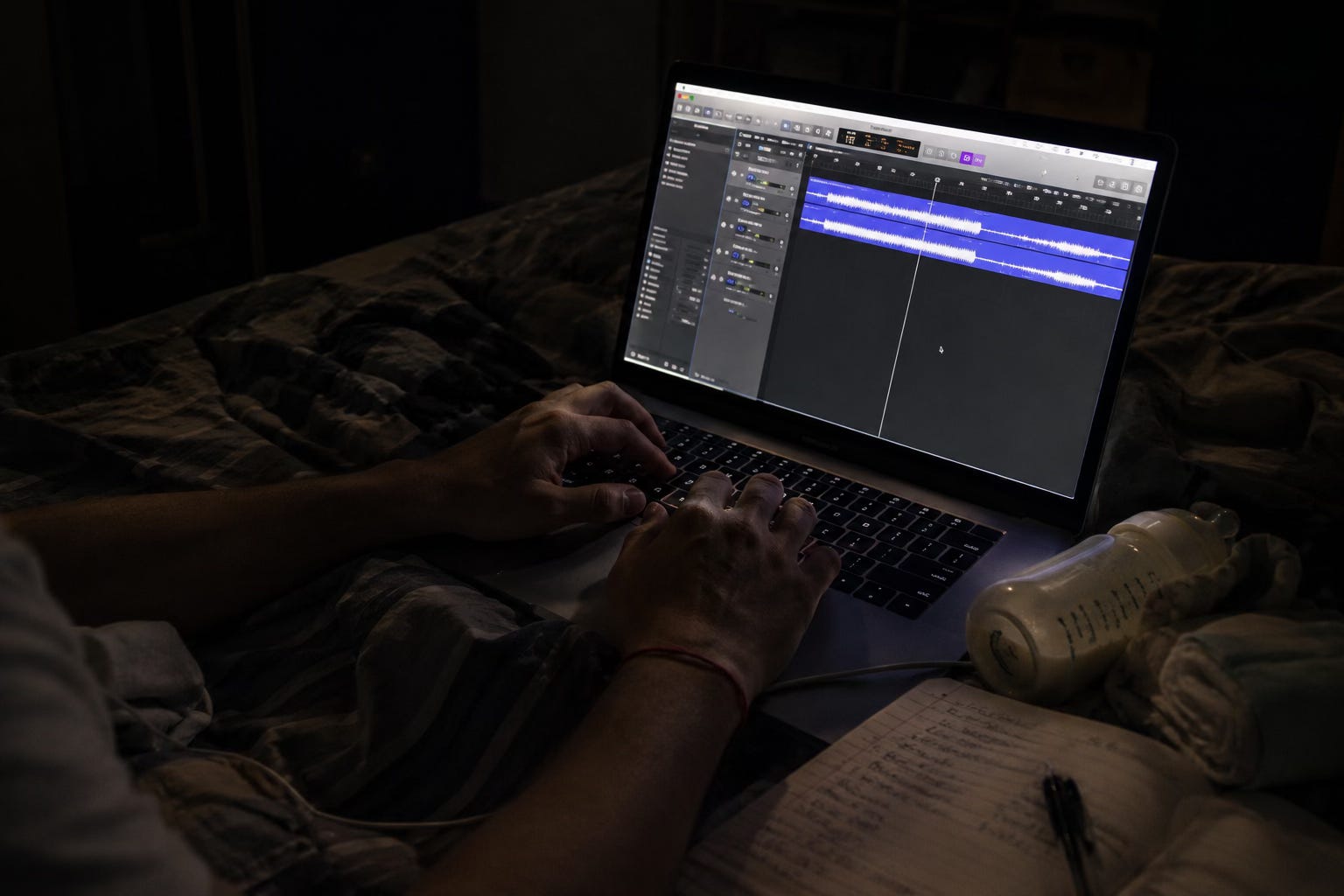
My wife and daughter were sleeping. The flat was quiet. I had my headphones on and GarageBand open on my laptop. I had been exploring what generative AI could do — feeding it fragments of thought and watching it structure what had always felt like chaos in my head. Then I discovered Substack. Then I realised a blog post could become a podcast. Then a cousin sister kept telling me — consistency, Saurav, consistency — and eventually I heard it.
I made a commitment. Once a month minimum. No excuses.
And that morning — 3:30am, headphones on, baby sleeping — I finished the first episode. Not my voice speaking. The AI voice reading my words back to me while I listened with my headphones.
When it played back I felt one thing.
At least I have something ongoing.
Not triumph. Not euphoria. Just quiet, steady forward movement. The feeling of a person who has been trying to build something for twenty years finally having something that is actually running.
Let it continue brewing, I thought. Maybe someday I will do this with a guest. Without the AI. With my own voice carrying the whole thing.
But for now — this was enough. This was real. This was mine.
The Algorithm Audit — What Fills The Space
One more piece of the London rebuild that belongs here.
The algorithm audit — which I have talked about in earlier episodes — began as a personal experiment in clearing space. Stop the passive consumption. See what is actually there when the feed goes quiet. That is the clearing.
But the more important question is what you fill that space with after the audit.
What I filled it with: structured learning. Serious podcasts. Long-form reading. The MSc material connecting to lived experience. The AI conversations that helped me pattern-match across decades of my own life. And eventually — the writing. The series. The work.
The audit does not make you productive.
It removes what was preventing you from being present.
That distinction — clearing versus building — is the difference between a digital detox and an actual change. Most people clear the space and then drift back to the same consumption within weeks. Building something intentional in that space is what makes the clearing permanent.
That is what the algorithm audit is really for.
Two recoveries. Different tools. Different countries. Same direction.
Both were slow. Both were unglamorous. Neither looked like progress from the outside.
But the soil had been prepared. And prepared soil doesn’t announce itself.
It just grows things when the conditions are right.
Next — Episode 7: Where I Am Now. The construction site, live. What has been built, what is still scaffolding, and what the whole thing is actually for.


