

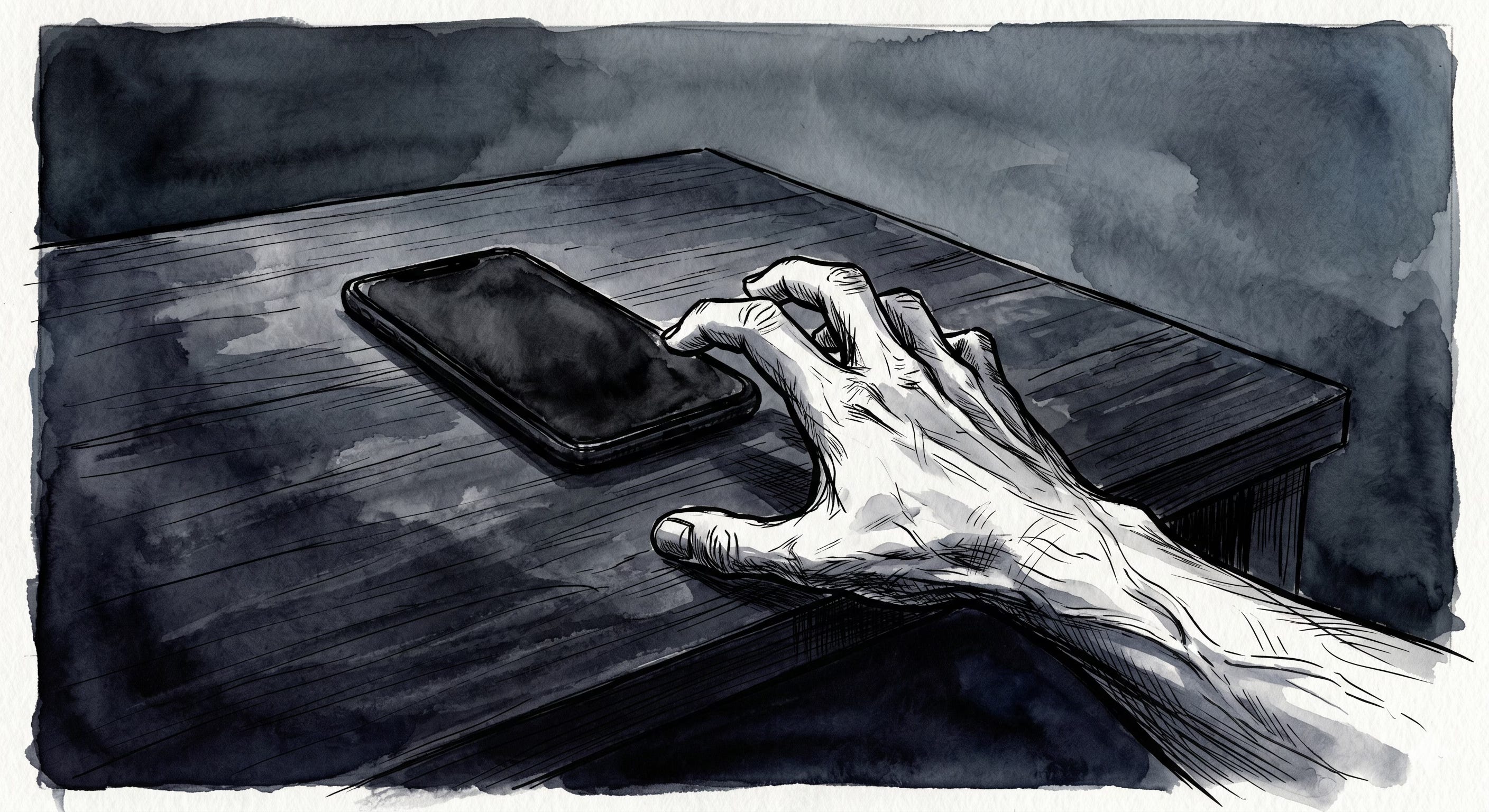
Last month, I ran a small experiment with seven professionals here in the UK.
Five completed it.
Two dropped out.
One participant gained back seven hours in a single week.
Another became aware, for the first time, of how much of their attention was being consumed by content they never consciously chose to follow.
But the most surprising result came from someone who did everything right.
They disabled notifications.
Removed distractions.
Followed the protocol carefully.
And by the end of the week, their screen time had gone up.
The algorithm was no longer knocking on the door.
They were walking back to it themselves.
I now call this the Phantom Effect.
It revealed something I hadn’t expected.
The biggest problem with modern feeds may not be the notifications. It may be the habits those notifications have already built inside us—quietly, over years, without our permission.
The Diaspora Version of the Problem
Those of us who have built lives across two countries carry a particular version of this challenge.
Our feeds are rarely about where we are going.
They are often anchored to where we came from.
Home-country news.
Family group forwards.
Political debates.
Cultural commentary that made sense when we lived there but now sits somewhere between comfort and distraction.
I know this personally.
I once wrote about the moment Facebook decided my family’s primary interest was mutton curry and proceeded to serve us recipes for weeks after a handful of interactions.
Funny at the time.
More interesting in hindsight.
Because every algorithm is making assumptions about who we are based on what we repeatedly consume.
The real question is whether those assumptions are helping us build the future we want—or quietly pulling us back toward an older version of ourselves.
This is not about abandoning your culture or your roots.
It is about noticing where your attention is actually going and deciding whether that is a conscious choice.
Most people can tell you how much money they spent this week.
Few can tell you where their attention went.
That asymmetry is worth sitting with.
What I Am Measuring
The experiment was the first pilot of something I call the Algorithm Audit—a seven-day protocol built around a concept I call Cognitive Capital.
Cognitive Capital is the attention, emotional energy, and mental bandwidth you invest into your day.
It is the resource from which careers, skills, businesses, relationships, and personal projects are built.
The pilot suggested that many of us are investing significant Cognitive Capital into content we never consciously chose—reactive inputs that arrive through our feeds, trigger a response, and pull us somewhere we did not intend to go.
For me, that habit was often political content from Nepal.
For someone else, it might be celebrity drama, football outrage, endless news cycles, or the daily emotional weather of a WhatsApp group.
The content itself is less important than the pattern.
The question is always the same:
Where is your Cognitive Capital being invested, and is that investment aligned with the life you are trying to build?
The Phantom Effect showed something deeper still.
Even when you remove the trigger, the habit remains.
The pull becomes internal rather than external.
Before we can change that, we need to see it clearly.
The Algorithm Audit Beta
The pilot gave me a baseline.
Now I want to scale it.
Seven participants are not enough to draw broad conclusions.
They are enough to reveal patterns worth investigating further.
So today, I am opening the Algorithm Audit Beta to the next fifty participants.
This is not a digital detox.
You do not need to delete your apps.
You do not need to disappear from your feeds.
For seven days, you will observe your habits and make four specific interventions:
Remove Algorithmic Interruptions
Silence non-human notifications and reduce unnecessary digital nudges.Audit Reactive Inputs
Identify the content patterns repeatedly capturing your attention.Train the Feed Intentionally
Engage with content aligned to your professional goals and interests.Create Boundaries
Reduce attention leakage and create space for intentional focus.
The process begins with a short baseline form.
Seven days later, you complete a follow-up reflection.
What I am looking for is not simply screen-time data.
I want to understand where Cognitive Capital is actually going—and whether intentional adjustments shift that investment in measurable ways.
If you have ever felt that your feed knows a version of you that no longer quite fits, this is the experiment for you.
Because you cannot redesign an environment you cannot see.


